

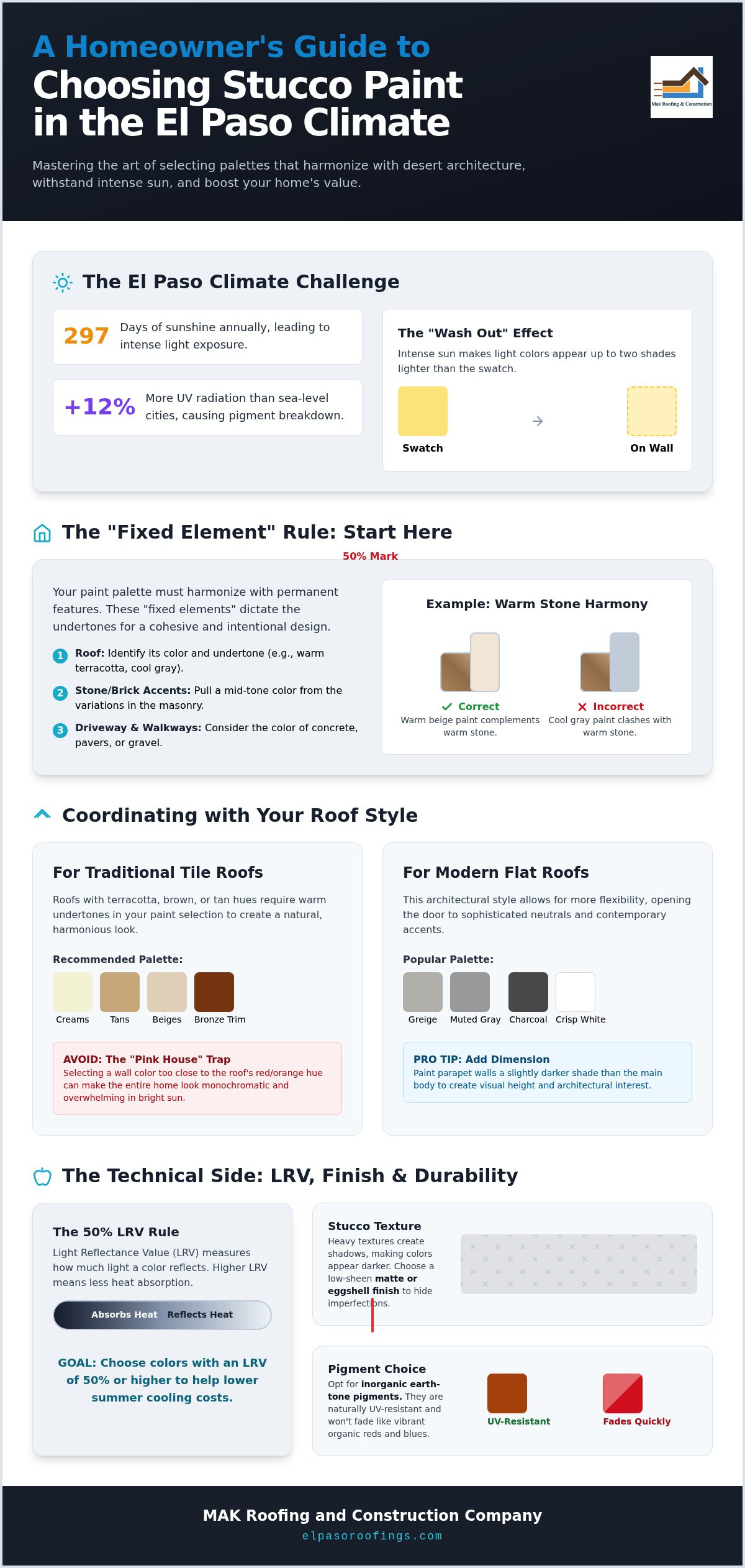
With 297 days of sunshine every year, the El Paso sun delivers up to 12 percent more UV radiation than sea-level cities. This environmental reality turns your home’s exterior into a high-stakes science experiment. You’ve likely noticed that the perfect sand-colored swatch you picked at the store looks like a blinding white sheet once it’s applied to your stucco. It’s frustrating when a color that should be warm ends up clashing with your tile roof or making your cooling costs soar because of heat absorption.
If you’re struggling to find the right balance, you aren’t alone. We understand that learning how to choose exterior paint colors for stucco homes in the Chihuahuan Desert requires a mix of aesthetic taste and technical knowledge. This guide will help you master the art of selecting palettes that harmonize with your architecture and boost your home’s value. We’ll explore the specific Light Reflectance Values that keep your home cool, the best trending desert tones for 2026, and how to select durable finishes that stand up to our unique climate for a decade or more.
Key Takeaways
- Learn how the intense El Paso sun “washes out” lighter shades and how stucco texture creates shadows that alter your final color depth.
- Identify the “Fixed Element” rule to ensure your new paint palette harmonizes perfectly with your existing tile roof, stone accents, and driveway.
- Discover a methodical approach for how to choose exterior paint colors for stucco homes that balance modern aesthetic trends with regional architectural heritage.
- Understand the 50% Light Reflectance Value (LRV) rule to manage solar heat absorption and effectively lower your home’s summer cooling costs.
- See why professional surface preparation and specialized elastomeric coatings are essential for a finish that resists thermal expansion and lasts for years.
Understanding Stucco and the Desert Environment
The El Paso climate demands a specific strategy when considering What is Stucco? and how it reacts to intense light. Our high elevation means the atmosphere is thinner, allowing up to 12 percent more UV radiation to hit your home’s exterior than at sea level. This environmental intensity often causes a “wash out” effect where light colors appear two shades lighter than they did on the swatch. Conversely, darker colors can absorb immense heat, potentially reaching surface temperatures that stress the underlying masonry. Understanding these dynamics is the first step in learning how to choose exterior paint colors for stucco homes that remain vibrant for years.
The UV Factor: Why Colors Fade in the Southwest
High UV exposure causes a chemical breakdown in paint pigments. Organic pigments, which are used to create vibrant reds, deep blues, and bright yellows, are particularly vulnerable to this solar bombardment. These colors often fade unevenly, leaving a blotchy appearance within just a few seasons. We recommend selecting colors formulated with inorganic earth tone pigments. These mineral-based colors are naturally resistant to UV degradation and are better suited for the harsh West Texas environment. Choosing a high-quality, UV-resistant coating isn’t just about aesthetics; it’s a necessary layer of protection for your home’s structural integrity.
Texture and Light: How Finish Affects Perception
Stucco texture plays a major role in how your eye perceives color. Heavy lace or skip-trowel finishes create thousands of tiny pockets of shadow. These shadows trap light, which often makes the overall wall surface look darker and more muted than a flat sample. Smooth finishes, while offering a sleek and modern aesthetic, reflect light more uniformly. They also tend to highlight every minor imperfection or hairline crack in the surface.
For the body of the home, we typically advise using a low-sheen matte or eggshell finish. These sheens hide texture inconsistencies and handle the desert’s high-glare environment better than glossy alternatives. When you are deciding how to choose exterior paint colors for stucco homes, remember that your choice must also account for breathability. Stucco is a porous material that needs to release moisture. If you apply a non-breathable film, you risk bubbling and premature failure. Finally, consider our regional dust and winds. Light, sandy neutrals hide El Paso’s ubiquitous dust much better than dark, saturated tones, reducing your long-term maintenance needs.
Coordinating Stucco with Your Roof and Fixed Elements
Successful exterior design begins with the “Fixed Element” rule. You must identify the components of your home that are permanent, such as the driveway, stone masonry, and the roof. These elements dictate your palette’s undertones. If you have a desert-inspired stone facade with gold and brown flecks, a cool blue-gray stucco will look disconnected and jarring. Instead, pull a mid-tone from the stone to ensure a cohesive look that feels intentional rather than accidental.
The Tile Roof Harmony: Warm vs. Cool Tones
Traditional clay tile roofing is a staple in El Paso, Horizon City, and Socorro. These roofs typically feature terracotta, deep brown, or tan hues. When you are determining how to choose exterior paint colors for stucco homes with these roofs, warm undertones are essential. Creams, beiges, and soft tans provide a natural transition between the heavy visual weight of the roof and the vertical surfaces of the walls.
A common mistake is selecting a wall color that is too close to the tile’s orange or red hue. This often results in the “pink house” trap, where the entire structure looks monochromatic and overwhelming under the bright midday sun. To avoid this, select a neutral with a yellow or peach base that provides contrast without clashing. Using a darker bronze or chocolate trim can ground the house, preventing the heavy tile roof from looking like it is crushing the lighter stucco body.
Modern Flat Roof Palettes
Modern architecture in Las Cruces and West El Paso often utilizes flat roofing systems. This structural style changes how to choose exterior paint colors for stucco homes, as it allows for more flexibility with “Greige” or even muted charcoal accents. Parapet walls offer a unique opportunity; painting them a slightly darker shade than the main body can create visual height and add architectural interest to a simple silhouette.
Because flat roofs often use high-reflectivity coatings or spray foam insulation, your stucco color should complement these functional choices. Light-colored walls help reduce heat absorption, which is critical for managing attic temperatures in our 110-degree summers. If you are unsure how your specific roof type impacts your color options, consulting with an expert in comprehensive exterior remodeling can ensure your roof and walls work together for maximum efficiency and style.
Finally, consider your yard as a color anchor. Desert xeriscaping with red volcanic rock or gray river stone provides a different backdrop than a lush green lawn. Match your stucco’s saturation level to your landscape to make the home feel like it belongs in its environment. A home that harmonizes with its surroundings always carries a higher perceived value and better curb appeal.
Popular Color Palettes for El Paso Stucco Homes
Selecting a palette is a significant decision. In regions like El Paso and Las Cruces, architectural styles range from historic treasures to modern desert silhouettes. When you are learning how to choose exterior paint colors for stucco homes, it’s vital to match the color to the home’s era. For instance, the “New Desert Modern” style relies on sophisticated grays and muted olives. These colors look grounded against our rocky terrain. In contrast, Traditional Spanish Colonial homes in districts like Manhattan Heights or Sunset Heights often require off-whites and deep ochres. If you live in these historic areas, your choices must be reviewed by the El Paso Historic Landmark Commission to ensure they meet preservation standards.
Contemporary Southwest designs are currently leaning toward high-contrast palettes. This often involves a light body color paired with dark bronze or black trim. However, you must be mindful of local regulations. In Horizon City and Socorro, many HOAs enforce an “Earth Tone” mandate. This means your primary color must fall within a specific range of browns, tans, or muted greens. Current 2026 trends for these areas favor Dunn-Edwards Adobe (DE6128) paired with a Cream (DE6213) trim. This combination meets regulatory requirements while maintaining a fresh, professional appearance.
Timeless Neutrals That Won’t Outdate
Antique White and Sandstone remain the gold standard for resale value. They provide a clean look that doesn’t feel dated after five years. To ensure your neutral doesn’t look yellow in the morning light, test your samples on the north and south sides of the house. We’ve found that Sherwin-Williams Cavern Clay (SW 7701) with Creamy (SW 7012) trim provides a warm, sophisticated balance that feels at home in the Chihuahuan Desert. Staying within this local landscape spectrum ensures your home looks established rather than out of place.
Bold Accents: Where to Use Color
Reserve bold colors for small architectural details. Front doors, shutters, and stucco “pop-outs” are perfect candidates for a splash of personality. A deep Adobe Brown (DE6080) body looks striking when paired with Saguaro Green or cobalt accents on the door. This “borderland Mexican vernacular” style adds character without causing the heat absorption issues associated with dark-colored walls. Properly coordinating these accents with professional trim finishes ensures a polished, start-to-finish look for your exterior transformation.

The Technical Side: LRV and Testing Your Selection
Selecting a color involves more than just aesthetics. In the high-heat environment of the Southwest, the technical specifications of your paint directly impact your home’s comfort and energy efficiency. One of the most critical metrics is Light Reflectance Value (LRV). LRV is the percentage of light a color reflects versus the amount it absorbs. For desert homes, professionals often recommend a “sweet spot” LRV between 55 and 75. This range is high enough to reflect significant solar energy but low enough to avoid the blinding glare that occurs with stark white finishes.
When you are researching how to choose exterior paint colors for stucco homes, you’ll find that mid-range tones are the most effective for thermal management. While dark colors may look modern, they absorb immense amounts of heat. This can lead to the “Heat Island” effect, where your home’s exterior walls radiate warmth long after the sun goes down. This thermal mass places unnecessary stress on your HVAC system and increases your monthly utility costs.
Thermal Performance and Energy Efficiency
Lighter stucco colors act as a functional partner to other efficiency upgrades like spray foam insulation. By reflecting the majority of the sun’s rays before they penetrate the wall surface, you create a dual layer of protection against the Texas heat. This combination is one of the most effective ways to lower cooling bills in El Paso and Las Cruces. If your home features a flat roofing system with a reflective coating, matching it with a high-LRV stucco color ensures your entire exterior envelope is working to repel heat.
The Swatch Test: Avoiding Costly Mistakes
You should never select a final color based on a digital screen or a small paper chip. Stucco’s unique texture creates micro-shadows that digital renderings cannot accurately simulate. We suggest using 2×2 foot samples applied directly to the wall to see the true result. It’s essential to test these samples on both the North and South sides of your home. A color that looks perfect in the soft, indirect light of a North-facing wall may look completely washed out on the South side under the direct noon sun.
Observe these samples at 8 AM, 12 PM, and 6 PM to see how the color shifts as the sun moves across the horizon. You must also evaluate the paint against your existing stone veneer or brick accents. If you want a cohesive look that protects your investment, consider a professional exterior assessment before finalizing your color choice. This methodical approach prevents the expensive mistake of repainting a home that doesn’t look the way you envisioned.
Professional Stucco Painting and Restoration
Selecting the right palette is only half the battle. Even the most sophisticated color choice will fail if the surface isn’t prepared with precision. In the El Paso region, professional preparation accounts for approximately 90 percent of a paint job’s success. This process begins with thorough power washing to remove decades of desert dust and chalking paint. Without this step, new coatings cannot form a proper bond, leading to premature flaking. Once the surface is clean, every imperfection is addressed through meticulous crack repair and surface stabilization.
When you are researching how to choose exterior paint colors for stucco homes, you must also consider the type of coating being applied. Standard exterior acrylic paints are often insufficient for our climate’s extreme thermal shifts. We frequently recommend elastomeric coatings for stucco surfaces. Unlike standard paint, elastomeric coatings are thick, flexible membranes that can bridge small gaps and stretch as the building expands and contracts in the summer heat. This elasticity prevents the hairline fractures that typically allow moisture to penetrate the masonry, ensuring your chosen color remains vibrant and your home stays protected.
Repairing Stucco Before You Paint
You must distinguish between minor spider cracking and significant structural issues before the first drop of paint is applied. Spider cracks are often cosmetic results of the curing process or minor settling. However, larger cracks can indicate moisture intrusion or foundation movement. Painting over damaged stucco without making repairs leads to bubbling, peeling, and trapped moisture. A professional assessment from a seasoned expert ensures that these issues are resolved correctly, providing a stable canvas for your new color palette.
The MAK Advantage: Comprehensive Exterior Care
We understand that a home’s exterior is an integrated system. MAK Roofing and Construction Company specializes in coordinating roofing, stucco application, and exterior painting to create a seamless transformation. This start-to-finish management style is particularly beneficial for homeowners in Horizon City, Socorro, and Las Cruces who want a cohesive look without managing multiple contractors. By handling the entire exterior envelope, we ensure that your new stucco color perfectly complements your tile roof and trim work.
To maintain your home’s appearance, we suggest a simple maintenance routine. Lightly rinse your stucco once or twice a year to prevent dust buildup from dulling the pigment. Perform a visual inspection after major windstorms to check for any new chips or impact damage. If you are ready to upgrade your home’s curb appeal with a durable, expert finish, Schedule your professional exterior consultation with MAK Roofing and Construction Company today. Our 16 years of local experience ensures a result that stands up to the unique environmental challenges of the Southwest.
Protecting Your Home’s Value and Comfort
Transforming your home’s exterior is a strategic investment that requires balancing visual appeal with the technical realities of the Chihuahuan Desert. By mastering how to choose exterior paint colors for stucco homes, you ensure your property remains energy efficient and architecturally harmonious. Selecting high-LRV tones and coordinating with your existing tile roof provides the foundation for a successful redesign. However, the longevity of that beauty depends entirely on proper surface restoration and specialized coatings that handle our extreme temperature swings.
MAK Roofing and Construction Company brings 16 years of local El Paso experience to every project. As A+ rated roofing and remodeling specialists, we provide comprehensive start-to-finish management for your stucco and painting needs. We don’t just apply color; we ensure the structural integrity of your home’s envelope is maintained for years to come. If you’re ready to enhance your curb appeal with precision and durability, Get a Professional Exterior Painting Estimate from MAK Roofing and Construction Company today. Your desert home deserves a finish that is as resilient as it is beautiful.
Frequently Asked Questions
Does painting stucco devalue a home?
Professional painting does not devalue a home; in fact, a high-quality application can yield a return on investment between 55% and 90% at resale. It refreshes the aesthetic and adds a critical protective layer against the elements. If you choose a color that aligns with regional trends, you’ll likely see an increase in property value. Poorly applied or clashing colors are the only real risks to valuation.
What are the most popular stucco colors in El Paso for 2026?
Current trends for 2026 favor Chihuahuan Desert blending and sophisticated neutrals. When homeowners ask how to choose exterior paint colors for stucco homes, we often suggest warm stone tones or soft sages. These palettes harmonize with the natural environment and help manage the visual impact of desert dust. Many residents are also opting for styles that pair a neutral body with a saturated accent door for a modern touch.
How often should a stucco house be repainted in the desert?
In the intense El Paso climate, you should plan to repaint your stucco every 4 to 5 years. The extreme UV exposure at our 3,800-foot elevation causes pigments to break down faster than in coastal regions. Regular maintenance prevents the stucco from becoming brittle. It also ensures the underlying masonry remains sealed against moisture and wind-driven sand, preserving the home’s structural integrity.
Can I paint my stucco a dark color in Texas?
You can paint your stucco a dark color, but it requires careful consideration of heat absorption. Darker shades absorb more solar energy; this can stress your HVAC system and cause the stucco to expand excessively. If you choose a dark palette, we recommend using cool-pigment IR colorants. These specialized paints reflect infrared light to keep the surface cooler than standard dark formulations, protecting your stucco from thermal stress.
What is the best type of paint to use on exterior stucco?
The best choice for our region is typically a high-quality elastomeric coating or a 100% acrylic masonry paint. These materials are essential when learning how to choose exterior paint colors for stucco homes because they bridge hairline cracks. These coatings are specifically engineered to handle the thermal expansion common in Texas and New Mexico, ensuring a durable finish that resists the harsh desert sun for many years.
How do I know if my stucco needs repair before painting?
You’ll know repairs are necessary if you see visible spider cracks, peeling paint, or areas where the stucco feels soft. Tap on the walls; a hollow sound often indicates that the stucco has separated from the lath. Painting over these issues is a mistake because moisture will remain trapped, leading to bubbling. A professional assessment identifies whether you need simple patching or more extensive restoration before the color is applied.
Do I need HOA approval to change my stucco color in Horizon City?
Yes, most neighborhoods in Horizon City and Socorro require formal HOA approval before you change your exterior palette. These organizations often have pre-approved color boards to maintain community standards. It’s vital to submit your swatches and wait for written confirmation before starting work. We often help clients navigate this process by providing professional samples that meet specific Earth Tone requirements for their specific subdivision.
What color stucco goes best with a brown tile roof?
Warm neutrals like cream, sand, or toasted almond pair best with a brown tile roof. These shades create a soft transition that doesn’t compete with the roof’s visual weight. If you want a more modern look, consider a muted sage or olive green. These colors provide a natural contrast while sharing the same warm undertones as the brown tiles, resulting in a balanced and grounded exterior that looks intentional.