

What if the cracked tile on your roof isn’t actually the reason your ceiling is leaking? In our harsh desert climate, a tile roof is only as good as the underlayment and thermal expansion management beneath the surface. When searching for tile roof repair Las Cruces homeowners often find that while the tiles themselves can last for decades, the protective layers underneath are far more vulnerable to the sun. You likely chose a tile roof for its iconic Southwest beauty and its reputation for longevity, so it is stressful to worry that a small leak might be masking significant structural damage or that a contractor might overcharge you for a simple fix.
We understand the need for a repair that is done correctly to code and provides long term security. This article provides an expert-backed checklist to help you identify specific damage, evaluate potential costs, and hire a specialist who truly understands tile systems rather than just shingles. You will learn how to spot the signs of underlayment failure and how to ensure your home stays leak-free while preserving its aesthetic value. We have designed this guide to give you the confidence to manage your roofing project with the authority of a seasoned local expert.
Key Takeaways
- Identify critical visual signs of damage like tile slippage and thermal expansion cracks that often precede major structural leaks.
- Use a specialized desert inspection checklist to evaluate vulnerable areas such as chimney flashing sealants and pest-resistant bird stops.
- Learn why the 20-year underlayment rule is the most important factor in deciding whether to repair or replace your roofing system.
- Find out how to verify if a specialist for tile roof repair Las Cruces uses high-temperature materials specifically rated for our 100-degree heat.
- Understand the importance of choosing a local expert who manages the complex structural relationship between your tile roof and desert stucco.
Essential Signs Your Las Cruces Tile Roof Needs Immediate Repair
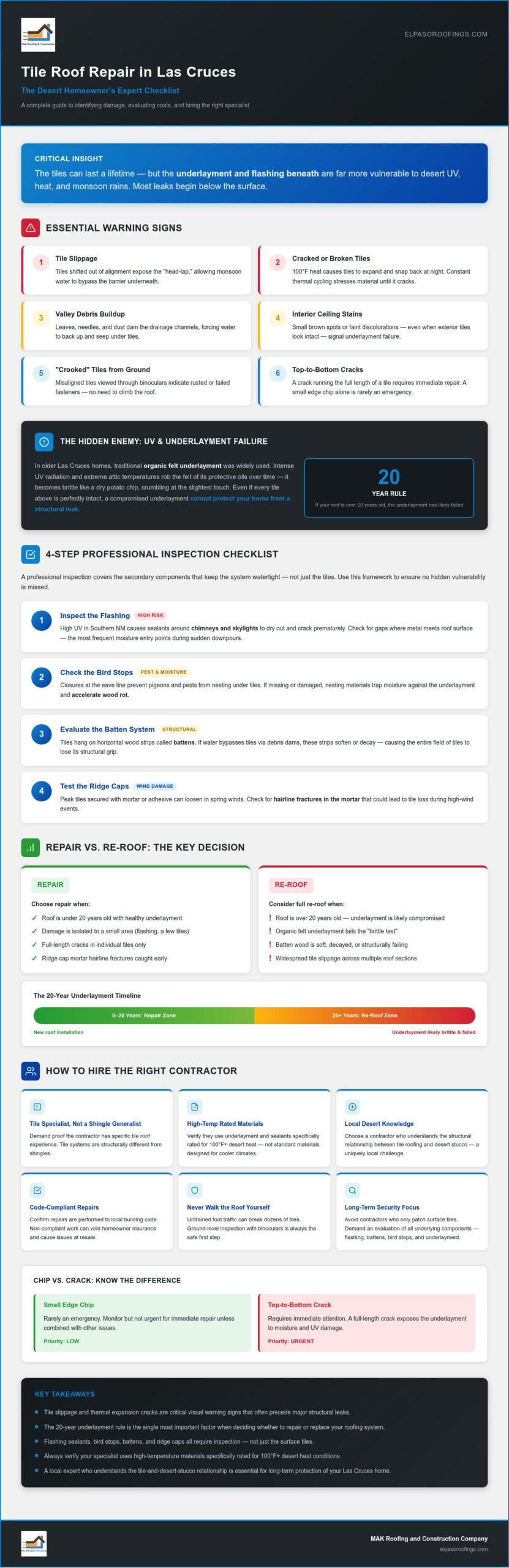
Tile roofing in the Chihuahuan Desert faces distinct environmental pressures that differ significantly from other regions. While a clay or concrete tile is designed to last a lifetime, the system as a whole is subject to movement and material fatigue. If you notice visual slippage, where tiles have shifted out of their original alignment, your roof is already at risk. This displacement often reveals the “head-lap,” the portion of the tile that should be covered by the one above it. When this area is exposed, water can bypass the primary barrier during our intense monsoon rains.
You should also monitor your roof for cracked or broken tiles. These are frequently caused by thermal expansion, where the tiles expand in the 100-degree heat and contract quickly during a desert evening. This constant movement can stress the material until it snaps. Additionally, debris buildup in the roof valleys is a common but overlooked issue. If needles, leaves, or dust accumulate in these channels, they act as a dam. This forces water to back up and travel under the tiles, which is a leading cause for homeowners seeking tile roof repair Las Cruces services. On the interior of your home, keep a close watch on your ceilings. Small brown spots or faint discolorations are often the first indicators that your underlayment has failed, even if the exterior looks intact.
The Hidden Enemy: UV Degradation and Underlayment
Your tiles function as a heat shield, but the underlayment is the true waterproof barrier. In older Las Cruces homes, traditional organic felt was often used. Over time, the intense UV radiation and extreme attic temperatures cause this felt to lose its oils. It becomes brittle, resembling a dry potato chip that crumbles at the slightest touch. If your roof is over 20 years old, it likely fails the “brittle test,” meaning the seal has evaporated. Even if every tile is perfectly in place, a compromised underlayment cannot protect your home from a structural leak.
Visual Cues from the Ground vs. The Roofline
You can identify many issues without ever leaving the ground. Use binoculars to spot “crooked” tiles, which typically indicate that the fasteners have rusted through or pulled out of the wood. You should also learn to distinguish between a cosmetic chip and a structural crack. A small chip on the edge of a tile is rarely an emergency, but a crack that runs from the top to the bottom of the piece requires immediate attention. You must never walk on your own tile roof to perform an inspection. Tile is fragile; the weight of an untrained person can easily break dozens of tiles, turning a minor tile roof repair Las Cruces project into a major financial burden.
The Comprehensive Tile Roof Inspection Checklist for Desert Homes
A professional inspection goes beyond looking for cracked tiles; it requires a methodical evaluation of the secondary components that keep the system watertight. When assessing the need for tile roof repair Las Cruces homeowners should follow this four-step framework to ensure no hidden vulnerability is missed. This process helps identify issues before they manifest as costly interior damage.
- Step 1: Inspecting the flashing. High UV exposure in Southern New Mexico causes sealants around chimneys and skylights to dry out and crack prematurely. We look for gaps where the metal meets the roof surface, as these are the most frequent entry points for moisture during a sudden downpour.
- Step 2: Checking the bird stops. These are the closures at the eave line that prevent pigeons and other pests from nesting under your tiles. If these are missing or damaged, nesting materials can trap moisture against the underlayment and accelerate wood rot.
- Step 3: Evaluating the batten system. Tiles typically hang on horizontal wood strips called battens. If water has been bypassing the tiles due to debris dams, these wood strips can soften or decay, causing the entire field of tiles to lose its structural grip.
- Step 4: Testing the ridge caps. The tiles along the peak of your roof are often secured with mortar or specialized adhesive. Our spring winds can vibrate these loose over time. We check for hairline fractures in the mortar that could lead to tile loss during high-wind events.
Checking the Valleys and Drainage Points
The valleys are the high-traffic areas for water runoff and are particularly vulnerable in our climate. You must verify that metal valley flashing is free of rust and sediment buildup. During our intense monsoons, even a small amount of desert silt can slow down water flow and cause “ponding” on low-slope sections. Ensure the eave closures are completely clear to allow proper water runoff. If you notice standing water or dark stains near drainage exits, it indicates a blockage that needs immediate attention.
Fastener and Batten Integrity
High wind uplift during Las Cruces wind storms puts immense pressure on tile fasteners, often stretching or loosening them over time. We also look for rusted nails that lead to “tile sliding,” a condition where tiles slowly migrate down the roofline and expose the underlayment. If the battens have rotted due to trapped moisture, the fasteners will no longer hold securely. If you suspect your roof has reached this stage of wear, it is wise to consult a local specialist who understands how to manage these integrated structural and stucco details.
Evaluating the Damage: When to Repair vs. When to Re-Roof
The most common dilemma for homeowners is deciding whether a few cracked tiles warrant a simple patch or a complete system overhaul. When determining the scope of tile roof repair Las Cruces projects, the most critical factor isn’t the tile itself; it’s the age of the underlayment. We follow the 20-year rule. If your underlayment is two decades old, it has likely reached the end of its pliable life. At this stage, the material becomes too brittle to handle the stress of being lifted and reset, making localized repairs a temporary and often ineffective solution.
Efficiency also plays a major role in this decision. If more than 20 percent of your tiles are broken or significantly shifted, the labor costs for individual replacements begin to rival the cost of a more comprehensive solution. You must also distinguish between localized and systemic failures. A localized leak is typically confined to a specific area, such as a damaged valley or a cracked chimney flashing. A systemic failure occurs when leaks appear in multiple rooms simultaneously, indicating that the entire waterproof barrier has reached its expiration date.
Modern synthetic underlayments have changed the landscape of roofing longevity. Unlike traditional felt, which dries out in the desert heat, high-performance synthetics are engineered to remain flexible for decades. Transitioning to these materials during a repair provides a more permanent fix that protects your home’s structural integrity far better than repeated felt patches.
The Cost-Benefit of ‘Lift and Reset’
For many Las Cruces homes with high-quality clay or concrete tiles, a “lift and reset” is the most logical path forward. This process involves carefully removing your existing tiles, replacing the failed underlayment with modern materials, and then reinstalling the original tiles. It’s a sustainable choice that preserves the classic Southwest aesthetic of your home while providing the security of a brand-new waterproof seal. A reset roof typically offers a lifespan that far exceeds a simple patch job, making it a superior long-term investment for your property.
When a Full Replacement is Non-Negotiable
There are circumstances where preserving the old tiles is no longer viable. If we identify structural deck rot or sagging rooflines during our inspection, the entire assembly must be removed to repair the underlying wood. Furthermore, if underlayment failure has spread across more than 30 percent of the surface, a full replacement is often the only way to guarantee a leak-free home. This is also an opportune time to upgrade to energy-efficient “cool” tiles. These specialized materials reflect more sunlight and can help reduce your cooling costs during our peak summer months.

Checklist for Hiring a Professional Tile Roofing Contractor in Las Cruces
Hiring for tile roof repair Las Cruces requires a different vetting process than standard shingle roofing. Tile systems are complex assemblies where the aesthetic outer shell relies on a hidden structural network. If a contractor treats a tile roof like a shingle roof, they risk causing more damage than they fix. You need a partner who understands the nuances of the desert environment and the specific materials used in Southern New Mexico architecture.
- Verify experience with clay vs. concrete: Clay tiles are more fragile and require delicate handling, while concrete tiles are heavier and put different stresses on the roof deck. Ask your contractor to demonstrate their experience with your specific material.
- Confirm high-temperature underlayments: Standard underlayments often fail when trapped between a hot tile and a roof deck in 100-degree weather. Ensure they use materials specifically rated for high-heat desert climates to prevent premature melting or seal failure.
- Ask about tile matching: Many older Las Cruces neighborhoods feature discontinued tile styles. A professional should have a process for sourcing matching salvaged tiles or identifying modern equivalents that won’t ruin your home’s curb appeal.
- Require a ’tile-safe’ crew: One of the leading causes of roof leaks is improper foot traffic. Your contractor should have a dedicated crew trained in specific walking patterns that distribute weight across the tiles to avoid breakage.
Licensing and Insurance for New Mexico Contractors
You must verify that any contractor you consider holds a valid license from the New Mexico Construction Industries Division (NM CID). This is your primary protection against substandard workmanship. Additionally, confirm they carry full workers’ compensation and liability insurance. Tile work is high-risk due to the weight of the materials and the slope of the roofs; you don’t want to be held liable for on-site accidents. Choosing a provider with local Las Cruces or El Paso proximity is also vital for warranty responses. If a leak occurs during a monsoon two years from now, you need a team that can be on-site quickly to honor their guarantee.
The Importance of a Detailed Written Estimate
A vague quote is a red flag. Your estimate should clearly state whether it includes the removal of old debris and the replacement of rotted wood battens. Ask for a breakdown of the warranty terms, distinguishing between the manufacturer’s warranty on the underlayment and the contractor’s warranty on their workmanship. A ‘hidden damage’ clause is a necessary contractual provision that accounts for structural rot or deteriorated decking that is only visible once the existing tiles and underlayment are removed. If you want to ensure your project is managed by a team that understands these local requirements, contact our specialized roofing team today for a comprehensive evaluation.
Protecting Your Investment with MAK Roofing’s Specialized Tile Services
MAK Roofing and Construction has spent 16 years perfecting the art of tile systems in the Southwest. We understand that the environmental demands of the Mesilla Valley are different from other regions. Our team specializes in tile roof repair Las Cruces homeowners can rely on for long-term stability. We don’t just fix leaks; we engineer solutions that account for the intense thermal expansion and monsoon cycles unique to our high-desert micro-climate.
We remain committed to using premium materials specifically designed to withstand sustained 100-degree heat. Many generic underlayments will degrade or even melt under the weight of a clay tile during a Southern New Mexico summer. We select components based on their durability and precision, ensuring that every layer of your roof provides a secure barrier against the elements. This commitment to quality is the foundation of our start-to-finish management style.
Our “More Than” philosophy sets us apart as a comprehensive project steward. In Las Cruces, a roof doesn’t exist in isolation; it’s intricately connected to your home’s stucco exterior. If the transition between the roofline and the stucco isn’t handled correctly, moisture will find a way in. Because we offer both roofing and stucco application, we ensure these two systems work together perfectly to protect your home’s structural integrity. The MAK Roofing guarantee is built on professional confidence and quiet authority on every job.
Custom Solutions for Las Cruces Architecture
Las Cruces is home to beautiful historic Adobe-style residences and complex modern tile patterns. These structures require a high level of craftsmanship to maintain their aesthetic value. We integrate specialized services like spray foam insulation and exterior painting to provide a complete protective envelope for your property. Whether you’re restoring a historic landmark or maintaining a contemporary home, we have the versatility to handle the project from start to finish. Our expertise in desert-specific roofing synergy ensures your home remains a source of pride.
Next Steps: Schedule Your Inspection
Getting started is a straightforward, low-friction process. When you contact our team for a professional assessment, we’ll schedule a visit to evaluate the current state of your tile system. During this first visit, we perform a methodical walkthrough to identify the hidden vulnerabilities related to tile roof repair Las Cruces residents often face. We provide a clear, declarative report on our findings so you can make an informed decision about your property. It’s our way of instilling a sense of security through established stability.
Schedule your professional tile roof inspection with MAK Roofing today.
Secure Your Home’s Long-Term Value
Your tile roof is a significant investment in your home’s structural health and Southwest aesthetic. You now know that the tiles are only the first line of defense. The true protection lies in the specialized underlayment and the precision of the installation beneath it. By using the checklists provided, you can move from a state of worry about hidden leaks to a position of informed authority. Identifying signs of desert-specific wear early is the best way to prevent a minor issue from becoming a major renovation.
When you need a partner for tile roof repair Las Cruces, MAK Roofing and Construction offers the stability of 16 years of local desert experience. We are A+ rated for reliability and craftsmanship, specializing in the unique demands of tile and flat roofing systems. We handle the complex synergy between your roof and stucco to ensure a complete, watertight seal. Don’t leave your home’s safety to chance. Get a Professional Tile Roof Repair Estimate from MAK Roofing today to protect your investment. Your home deserves the durable protection that only a seasoned local expert can provide.
Frequently Asked Questions
How much does tile roof repair usually cost in Las Cruces?
The cost of your project depends on several variables, including the type of tile, the extent of underlayment damage, and the pitch of your roof. Because every home has unique requirements, we provide detailed, personalized estimates rather than general price ranges. A professional inspection is the only way to accurately determine if you need a localized fix or a more comprehensive system reset.
Can I replace just a few broken tiles myself?
DIY tile replacement is not recommended because of the high risk of breaking surrounding tiles. You must use specific walking patterns to distribute your weight across the strongest points of the tile. Most homeowners find that attempting a self-repair often leads to more damage, making a professional tile roof repair Las Cruces service a more cost-effective choice in the long run.
How long do tile roofs actually last in the New Mexico desert?
The tiles themselves are incredibly durable and can last between 50 and 100 years in our dry climate. However, the waterproof underlayment beneath those tiles has a shorter lifespan. In the Las Cruces environment, you can expect traditional felt underlayment to last approximately 20 to 25 years before it becomes too brittle to protect your home effectively.
What is the best underlayment for a tile roof in a hot climate?
High-temperature synthetic underlayments are the most reliable option for our 100-degree desert summers. These materials are specifically engineered to withstand extreme heat without melting or becoming brittle like traditional organic felt. Choosing a high-quality synthetic ensures your roof remains watertight for decades, even when attic temperatures reach their peak during the hottest months of the year.
Why is my tile roof leaking even though the tiles look perfectly fine?
A leak often indicates that the underlayment has failed, even if the exterior tiles appear to be in excellent condition. While tiles shed the bulk of the water, the underlayment is the final waterproof barrier for your home. If that material has cracked due to age or heat, moisture will bypass the tiles and penetrate your ceiling during a heavy monsoon rain.
Do I need a permit for tile roof repair in Las Cruces, NM?
Permit requirements generally depend on the scope of the work being performed. Minor repairs might not require a permit, but significant structural work or a full re-roofing project typically does. It is best to verify current regulations with the New Mexico Construction Industries Division (NM CID). Professional contractors usually manage the permitting process as part of their comprehensive project stewardship.
Will my insurance cover tile roof repair after a Las Cruces wind storm?
Insurance coverage for tile roof repair Las Cruces depends on whether the damage was caused by a sudden, covered event like a wind storm or hail. Policies typically don’t cover leaks caused by old age or a lack of maintenance. You should consult with a professional specialist to document the damage and determine if it meets the criteria for a legitimate insurance claim.
How can I tell if my roof tiles are clay or concrete?
You can tell the difference by looking at the color and the interior of the tile. Clay tiles are usually the same color all the way through, meaning a chip will reveal the same orange or red hue. Concrete tiles are often gray on the inside with a painted or glazed surface, and they tend to be heavier and thicker than their clay counterparts.