

- BY
- POSTED IN Uncategorized
- WITH 0 COMMENTS
- PERMALINK
- STANDARD POST TYPE
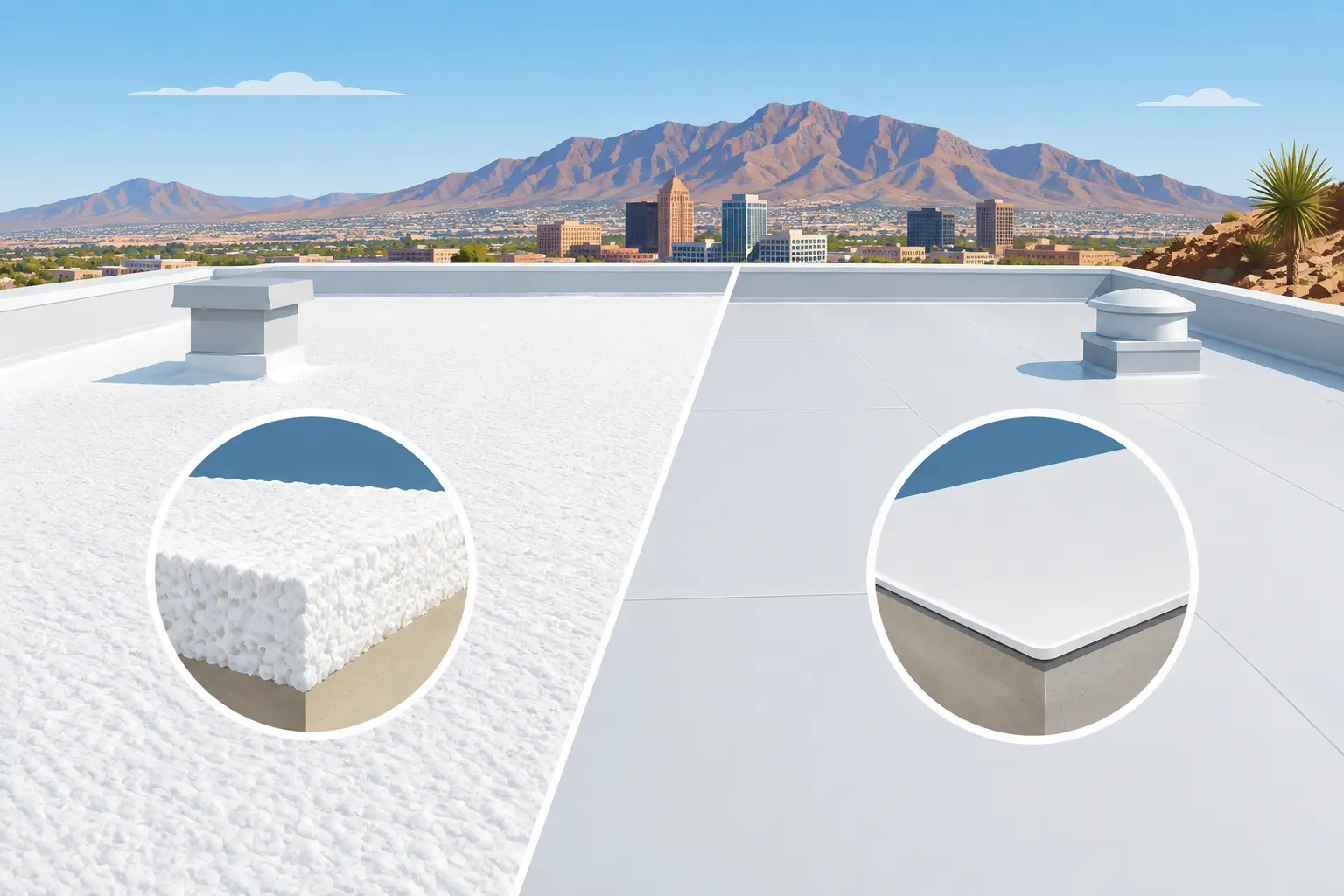
A flat roof in El Paso has to stand up to more than sunlight. It faces intense UV exposure, large temperature swings, wind-driven dust, and sudden monsoon rain. When property owners compare foam versus TPO, the right answer comes down to the roof’s shape, drainage, condition, energy goals, and how the building is used.
Spray polyurethane foam and TPO are both proven commercial and residential low-slope roofing options. They work in very different ways, however. One is a sprayed, fully adhered insulation and roofing system. The other is a manufactured single-ply membrane installed in sheets and heat-welded at the seams. Understanding those differences helps prevent a short-term choice from becoming a long-term headache.
Foam Versus TPO: The Core Difference
Spray foam roofing, often called SPF roofing, is applied as a liquid that expands into a solid foam layer. It is installed directly over a properly prepared roof deck or, in some cases, over an existing roof system. A protective elastomeric coating is then applied over the foam to shield it from sunlight and weather.
TPO stands for thermoplastic polyolefin. It is a white roofing membrane that comes in rolls. Professional crews attach it to the roof with adhesive, fasteners, or a ballasted assembly depending on the building and roof design. The seams are hot-air welded together, creating a continuous water-resistant surface.
Both systems can perform well when correctly designed and installed. The choice is not simply a matter of picking the material with the best reputation. A roof must fit the property.
When Spray Foam Roofing Makes Sense
Foam roofing is often a strong option for roofs with irregular shapes, many penetrations, or hard-to-flash details. Pipes, curbs, equipment supports, skylights, and transitions can create vulnerable spots on a flat roof. Because foam is sprayed in place, it conforms around these areas without relying on overlapping sheets or mechanical seams.
The insulation value is another major advantage. Spray foam delivers a high R-value per inch, helping reduce heat transfer through the roof. For an El Paso home, office, warehouse, or retail building with high cooling demands, that can improve interior comfort and help control energy use. Foam can also add slope in targeted areas to improve drainage when used as part of a properly planned roofing system.
A foam roof is lightweight and can sometimes be installed over an existing roof, reducing tear-off debris and project disruption. That possibility depends on the current roof’s moisture condition, structural capacity, and local code requirements. A wet or failing roof cannot simply be covered and forgotten. It needs to be evaluated before any new system goes on top.
Foam also has a practical repair advantage. Small damage can often be cleaned, dried, repaired with compatible materials, and recoated without replacing large sections of roofing. This makes routine inspections especially valuable. A small puncture that is caught early is usually straightforward. One left exposed can allow moisture into the foam and underlying roof assembly.
The trade-off is maintenance. The protective coating is not optional. It is the layer that protects the foam from UV exposure, so it must be inspected and renewed when its condition calls for it. Foot traffic, dropped tools, hail, and neglected penetrations can damage the coating. Foam roofs are durable systems, but they require an owner who is willing to keep up with scheduled maintenance.
When TPO Is the Better Fit
TPO is a familiar choice for larger, open commercial roofs. Its white surface reflects sunlight, which can help reduce heat absorbed into the building. It is also a good fit for property owners who want a membrane system with heat-welded seams and a clean, uniform appearance.
A properly installed TPO roof has strong seam performance because the sheets are fused together with hot air rather than joined only with adhesive. That matters on roofs where water movement, wind exposure, and expansion and contraction put stress on the roofing system. Quality installation is critical – welding temperature, speed, overlap, and testing all affect the finished roof.
TPO can be an efficient option on broad roofs with relatively simple layouts. It is commonly used on offices, retail spaces, multifamily buildings, and other commercial properties. It can also be installed on certain residential low-slope roofs where the design and appearance are appropriate.
The limitation is that every seam, edge, penetration, and transition must be detailed correctly. A roof with many mechanical units or unusual shapes may require more labor and more attention to flashing details than an open, uncomplicated roof. TPO is not a poor choice for complex roofs, but its installed performance depends heavily on experienced workmanship at those details.
TPO membranes can also be punctured by sharp objects or repeated service traffic. Walk pads may be needed around HVAC equipment or common access routes. Facility managers should not assume a membrane roof is maintenance-free just because it looks smooth and intact from the ground.
Drainage Can Decide the Question
Neither foam nor TPO should be selected without looking at drainage. Standing water is one of the most common warning signs on a low-slope roof. It may point to clogged drains, inadequate slope, structural deflection, or a roof design that does not move water where it needs to go.
Foam can be especially useful when minor slope correction is needed because it can be built up in selected areas. However, it should not be treated as a quick fix for serious drainage problems. If the roof deck is compromised or the drainage layout is inadequate, the underlying issue should be corrected first.
TPO can perform very well on a roof with sound slope, properly placed drains, and properly detailed scuppers. On roofs prone to ponding water, the membrane thickness, attachment method, substrate condition, and drainage strategy deserve careful review. The roof system is more than its top layer.
Installation Quality Matters More Than Material Claims
A high-quality material cannot compensate for poor surface preparation, weak flashing, trapped moisture, improper seam welding, or skipped maintenance. Before choosing either system, a professional roof inspection should identify the existing roof assembly, insulation condition, deck type, drainage pattern, penetrations, and areas of active leakage.
For foam, preparation may include removing loose materials, repairing damaged areas, drying the substrate, and addressing seams or transitions before spraying. The foam thickness and coating system should be designed for the building, not applied as a one-size-fits-all solution.
For TPO, the installer must select the appropriate membrane thickness, attachment method, insulation package, and edge detailing. The crew should also test welded seams and properly flash every roof penetration. These steps are not extras. They are part of delivering a roof that can hold up through El Paso weather.
Cost, Lifespan, and Long-Term Planning
Upfront cost matters, but it should be viewed alongside maintenance needs, insulation performance, roof complexity, and expected service life. Foam can be cost-effective on complex roofs and may reduce energy loss through added insulation. Its coating will need periodic renewal, which should be included in the long-term budget.
TPO may be a practical value on large, open roof areas, particularly when a reflective membrane and a conventional commercial roofing assembly are the right fit. Its future costs may involve repairs at penetrations, seams, and areas exposed to foot traffic, along with routine inspections and cleaning.
The least expensive proposal is not always the lowest-cost roof over time. A better question is whether the proposed system addresses the condition of the current roof, handles water correctly, supports the building’s energy needs, and comes with workmanship and material protection appropriate for the investment.
Choosing the Right Roof for Your Property
Choose foam when the roof has complex details, added insulation is a major priority, or targeted slope improvement may be needed. Choose TPO when the roof has broad open areas, a membrane system suits the building design, and professional heat-welded seams are the preferred approach. In some cases, roof coatings, modified bitumen, or another system may be a better answer than either option.
MAK Roofing & Construction evaluates the full roof condition before recommending a system, including drainage, insulation, existing materials, and the demands placed on the building. That approach helps homeowners and commercial property owners make decisions based on real conditions rather than a generic sales pitch.
If a roof is leaking, showing ponding water, or nearing the end of its service life, schedule an inspection before damage spreads below the surface. The best roof is the one built for your property, maintained with care, and installed by a crew that takes responsibility for the details.