

- BY adminMak
- POSTED IN Blog
- WITH 0 COMMENTS
- PERMALINK
- STANDARD POST TYPE

Last Updated: November 3, 2026
Quick Summary
The best commercial roofing materials for El Paso are TPO, metal, EPDM, PVC, and modified bitumen, ranked by how well each handles heat, UV, wind, and sudden monsoon rain. TPO leads for reflective, energy-efficient low-slope roofs, while metal offers wind and fire resistance and PVC suits restaurants and industrial buildings with chemical exposure.
- El Paso roofs face summer surface temperatures far above air temperature plus heavy monsoon downpours after long dry stretches.
- TPO’s heat-welded seams fuse watertight when installed correctly, but rushed welds cause early seam failure.
- Standard black EPDM absorbs heat, so price a reflective coating from the start rather than adding it later.
- PVC generally costs more than TPO or EPDM, so choose it only when your building needs chemical resistance.
- Modified bitumen is labor-intensive to install but shrugs off foot traffic and dropped tools better than thin membranes.
Table of Contents
- Why El Paso’s Climate Demands Specific Commercial Roofing Materials
- 1. TPO: The Energy-Efficient Single-Ply Leader
- 2. Metal Roofing: Built for Wind and Longevity
- 3. EPDM: Proven Rubber for Flat Commercial Roofs
- 4. PVC: Chemical-Resistant and Fire-Retardant
- 5. Modified Bitumen: Puncture Resistance for High-Traffic Roofs
- Commercial Roofing Material Cost: What Drives the Price
- TPO vs. EPDM Commercial Roofing: Which Wins in El Paso?
- Frequently Asked Questions
Why El Paso’s Climate Demands Specific Commercial Roofing Materials
Choosing commercial roofing materials in El Paso isn’t a copy-paste decision from a national catalog. This city throws four stressors at a roof, and most generic guides plan for one.
The short version: the best commercial roofing materials for El Paso are TPO, metal, EPDM, PVC, and modified bitumen, ranked by how well each handles heat, UV, wind, and sudden monsoon rain. Below: how each performs, what drives cost, and which fits your building.
Sun, Heat, Wind, and Monsoon Rain: What Your Roof Faces
El Paso sits in the Chihuahuan Desert, so a roof here faces conditions a mild climate never sees.
Then the rain arrives. El Paso gets infrequent but heavy monsoon downpours, often after months of dry heat. A roof that drains poorly or has weak seams will find every flaw during the first big storm.
The National Weather Service El Paso forecast office tracks this pattern closely: long dry stretches followed by intense summer storms.
Watch out: choosing a material on upfront price alone can lead to ponding water repairs within a few seasons.
The Five Materials That Handle It Best
We rank these five on El Paso suitability, not national popularity. Each earns its place for a specific reason and carries a real trade-off. For a side-by-side before you commit, our flat roof system comparison for El Paso properties breaks down TPO, spray foam, modified bitumen, and coatings on heat, drainage, budget, and longevity.
| Material | Best For | Key Strength | Main Trade-Off |
|---|---|---|---|
| TPO | Sunny low-slope roofs | Reflective, energy-efficient | Seam quality depends on installer |
| Metal | Long-term durability | Wind and fire resistance | Higher upfront cost |
| EPDM | Temperature swings | Proven, easy to repair | Dark color absorbs heat |
| PVC | Restaurants, industrial | Chemical and fire resistance | Costs more than TPO or EPDM |
| Modified Bitumen | High-traffic roofs | Puncture resistance | Labor-intensive install |
1. TPO: The Energy-Efficient Single-Ply Leader
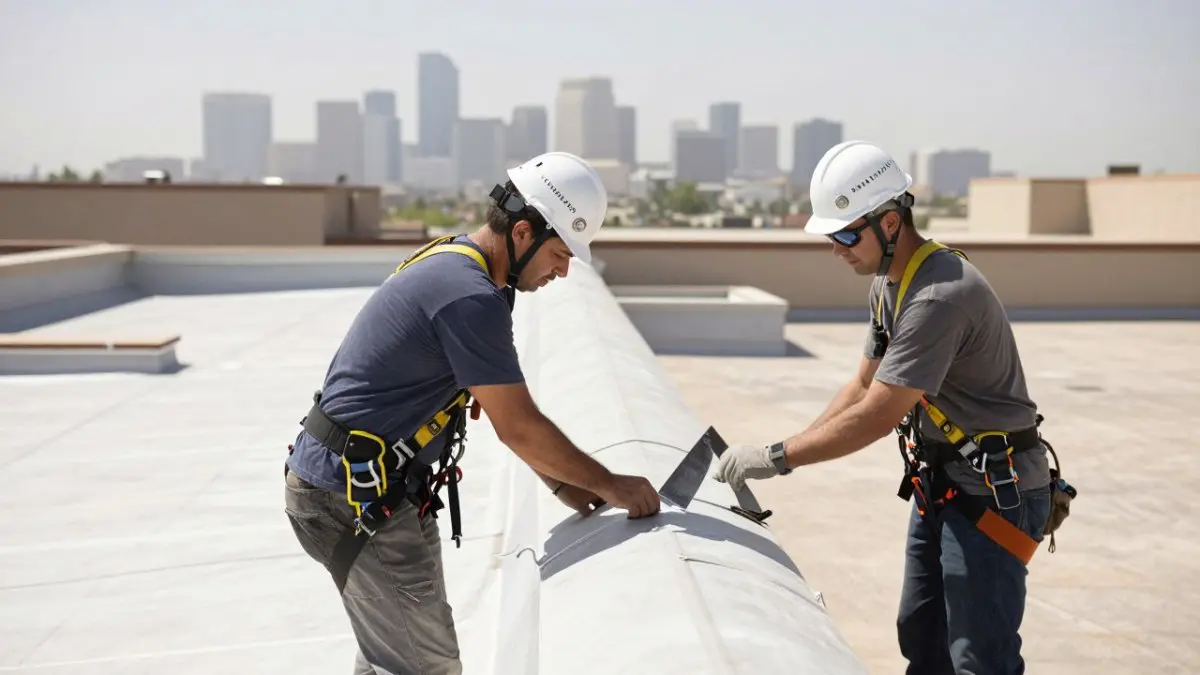
TPO, or thermoplastic polyolefin, is a single-ply reflective membrane that keeps cooling loads down in a city where the sun does most of the damage.
Heat-welded seams are a notable feature: installed correctly, they fuse into a watertight bond. TPO is a common first consideration for flat commercial roofs in El Paso’s sun belt.
The honest limitation: seam failure is real when crews rush the weld. Our foam versus TPO comparison for El Paso flat roofs covers installation, insulation, drainage, and maintenance side by side.
Best for: sun-exposed low-slope roofs where energy efficiency and reflectivity matter.
Skip if: your building sees heavy chemical or grease exposure, where PVC wins.
2. Metal Roofing: Built for Wind and Longevity
Metal roofing is often chosen for durability.
The trade-offs are real: metal costs more upfront than single-ply membranes and can be noisy during heavy rain, which matters if people work directly beneath the deck.
Metal’s wind performance depends on fastening and panel profile as much as the metal itself.
Best for: owners planning to hold a building for decades and wanting low maintenance.
Skip if: your budget is tight and your building has a short hold period.
3. EPDM: Proven Rubber for Flat Commercial Roofs
EPDM, or ethylene propylene diene monomer, is a synthetic rubber membrane with a long, proven track record on flat commercial roofs.
Large rolls mean fewer seams, and EPDM is generally considered easy to repair.
The drawback is color. Standard black EPDM absorbs heat, which can push cooling costs up in El Paso’s summer. Reflective coatings can offset that, but it’s a factor to price in from the start.
Best for: flat roofs in regions with significant temperature swings and owners who value easy repairs.
Skip if: you want maximum reflectivity out of the box without adding a coating.
4. PVC: Chemical-Resistant and Fire-Retardant
PVC, or polyvinyl chloride, is a flexible thermoplastic membrane that resists chemicals, grease, and fire.
PVC is inherently fire-retardant and uses strong heat-welded seams, the same technology that makes TPO reliable. It also resists oils and chemical pollutants that would degrade lesser membranes over time.
The catch is cost. PVC generally runs more than TPO or EPDM, so it makes sense when your building actually needs the chemical resistance.
Best for: restaurants and industrial facilities with grease or chemical exposure.
Skip if: your roof sees no chemical load and budget is the priority.
5. Modified Bitumen: Puncture Resistance for High-Traffic Roofs
Modified bitumen is an asphalt-based system reinforced with polymers for strength and flexibility. It’s a multi-layer system with high tensile strength, available in torch-applied or self-adhered options depending on the project.
Where it earns its spot is puncture resistance.
The downside is installation. Modified bitumen is labor-intensive, which can stretch timelines and add cost. It’s a proven performer across climates, but the install crew’s skill matters as much as the material.
Best for: commercial buildings with high foot traffic or rooftop equipment.
Skip if: speed of installation is your top priority.
Commercial Roofing Material Cost: What Drives the Price
Commercial roofing material cost in El Paso is driven by four things: material type, roof size and complexity, insulation and drainage requirements, and labor. The useful version for a building owner is a qualified range per square foot plus the lifecycle math behind it, so you can compare total cost of ownership instead of sticker price. For a concrete breakdown of TPO, bitumen, and foam systems, see our flat roof replacement cost guide for El Paso.
Pricing depends on your building, roof condition, and project scope. Request a quote from MAK Roofing & Construction’s website for current pricing.
| Material | Typical installed range (per sq ft) | Expected service life | Maintenance profile |
|---|---|---|---|
| TPO (60 mil) | $6.50-$10.50 | 15-25 years | Seam inspection after monsoon season; coating refresh optional |
| EPDM (60 mil) | $5.50-$9.00 | 15-25 years | Patching is simple; reflective coating adds cost but cuts heat gain |
| PVC (60-80 mil) | $8.00-$13.00 | 20-30 years | Low; chemical resistance reduces grease-related repairs |
| Modified bitumen (2-ply) | $6.00-$11.00 | 15-20 years | Higher; traffic wear and flashing checks |
| Standing-seam metal | $10.00-$18.00 | 30-50 years | Low; fastener and sealant checks at penetrations |
In El Paso, the lowest initial bid is not always the lowest-cost roof over its service life. Consider service life and maintenance, not only year-one cost.
What moves the number up or down:
- Material choice: metal and PVC sit at the high end per square foot; TPO and EPDM sit lower; modified bitumen lands in between depending on layers.
- Roof complexity: penetrations, skylights, equipment pads, and parapet details add labor faster than most owners expect.
- Insulation and drainage: added insulation and tapered drainage raise cost but pay back in energy and ponding control, and ponding is the leading cause of premature membrane failure here.
- Tear-off vs. recover: removing an old roof costs more than recovering over it where code and deck condition allow, but a recover over a wet assembly traps moisture and shortens the new roof’s life.
- Season and access: summer heat limits crew hours, and limited roof access or staging raises labor.
Pricing depends on your specific building, so the reliable path is to request a quote from MAK Roofing & Construction’s website.
TPO vs. EPDM Commercial Roofing: Which Wins in El Paso?
TPO vs. EPDM commercial roofing comes down to reflectivity versus repairability, but the El Paso decision is more specific.
Where TPO wins in El Paso: TPO’s white surface reflects solar radiation, which matters on a low-slope roof baking through a desert summer.
The decision factors that actually separate them:
- Slope and drainage: on a roof with marginal slope or known ponding, TPO’s welded seams and lighter membrane handle standing water better; EPDM’s adhesive seams are more vulnerable to prolonged ponding.
- Building use: a restaurant or kitchen with grease exposure should skip both and look at PVC. A warehouse with rooftop traffic may favor modified bitumen’s puncture resistance.
- Structural capacity: both are lightweight single-ply systems, so either works on most commercial decks, but added insulation and ballast change the load and should be checked.
- Occupancy and downtime: heat-welded TPO installs cleanly with fewer adhesives and odors, which matters for occupied buildings.
- Hold period: if you plan to sell in five years, EPDM’s lower upfront cost may win; if you are holding 20 years, TPO’s reflectivity and seam performance usually pay back.
The reverse mistake is paying for TPO on a roof with chronic ponding and no drainage correction, where any membrane fails early.
Watch out: seam quality decides the outcome for both materials.
Before you sign with any contractor, ask the right questions. Our guide on questions to ask your commercial roofing contractor covers what separates a reliable crew from one that disappears mid-job. And because monsoon season is the real test, our monsoon weather roof preparation guide shows how to get drainage and repairs storm-ready.
Frequently Asked Questions
What are the top 5 commercial roofing materials for El Paso buildings?
The five best commercial roofing materials for El Paso are TPO, metal roofing, EPDM, PVC, and modified bitumen. TPO leads for energy efficiency and heat-welded seams, metal excels in wind resistance and lifespan, EPDM handles temperature swings well, PVC resists chemicals and fire, and modified bitumen offers puncture resistance for high-traffic roofs. Each material suits different building types, so match your choice to your roof slope, traffic, and energy goals.
Which is better for a commercial roof in El Paso, TPO or EPDM?
TPO generally wins in El Paso because its reflective white surface reduces cooling costs in intense sun, while EPDM’s dark color absorbs heat. TPO also uses heat-welded seams that resist monsoon rain better than EPDM’s adhesive seams. However, EPDM is more flexible and easier to repair, and it performs well on roofs with significant temperature swings. For most El Paso commercial buildings focused on energy efficiency, TPO is the stronger choice.
How much does commercial roofing material cost in El Paso?
Commercial roofing material cost varies widely by material, roof size, and installation complexity. Pricing varies by material, square footage, and seam requirements. Modified bitumen falls in the mid-range. For an accurate figure, request a video estimate from a local contractor who can assess your roof’s condition and slope.
Which commercial roofing materials are most energy-efficient in El Paso’s hot, sunny climate?
TPO and PVC are the most energy-efficient commercial roofing materials for El Paso. Both are reflective white membranes that bounce solar radiation away from the building, lowering cooling loads during summer. Metal roofing with a cool-roof coating also performs well. EPDM, especially in dark colors, absorbs heat and can increase cooling costs. Pair any reflective material with proper roof insulation to maximize energy savings.
How long do commercial roofing materials typically last in El Paso?
Metal roofing lasts 30+ years, PVC offers a very long service life, and TPO and EPDM typically last 15 to 25 years depending on installation quality and maintenance. Modified bitumen lasts around 15 to 20 years. El Paso’s UV intensity and monsoon rain can shorten lifespan if seams fail or drainage is poor, so schedule annual inspections and keep ponding water off the roof to get the full service life from any material.
El Paso roofs don’t get to coast on mild weather, so the material decision deserves more than a quick quote. MAK Roofing & Construction brings over 16 years of experience, custom-designed roofing systems built for El Paso’s climate, and full-service project management from start to finish, with bank financing options available. Get started with MAK Roofing & Construction and choose a commercial roof built to handle the sun, wind, and monsoon rain.
