

- BY
- POSTED IN Blog
- WITH 0 COMMENTS
- PERMALINK
- STANDARD POST TYPE

Table of Contents
- What JFC Construction Offers vs. What Full-Service Contractors Provide
- Stucco Repair Services: What to Expect from a Qualified Contractor
- Home Remodeling Contractor Checklist Before You Sign Anything
- How to Verify Contractor Insurance and Licensing
- JFC Construction vs. MAK Roofing & Construction: Service Depth Compared
- Sustainability and Construction Methods Worth Asking About
- Getting a Quote and What Happens Next
- Frequently Asked Questions
Last Updated: August 25, 2026
Searching for a contractor in the El Paso area means sorting through a lot of business listings, word-of-mouth referrals, and directory profiles that tell you very little about actual service quality. This guide from MAK Roofing & Construction breaks down what jfc construction services look like in practice, how to evaluate any full-service contractor before signing, and where the real differences in service depth show up. Below, we cover everything from stucco repair expectations to financing questions to the sustainability questions worth raising before a single nail goes in.
The goal here is straightforward: give homeowners and property managers the framework to make a confident, informed hiring decision.
What JFC Construction Offers vs. What Full-Service Contractors Provide
A full-service contractor is one that manages the complete scope of a construction or renovation project, from initial site preparation through final inspection, without requiring the owner to coordinate separate subcontractors. That definition matters because not every company advertising “general contractor” services actually operates that way.
According to the National Association of Home Builders’ contractor resource guide, homeowners who hire a single point-of-contact contractor for complex projects report significantly fewer scheduling conflicts and cost overruns than those who self-coordinate multiple trades.
JFC construction, as listed across local directories, covers residential roofing and general construction work. Understanding what that scope includes, and where it stops, is the first step in deciding whether it fits your project.
Residential Roofing and General Construction
JFC Roofing & Design has operated as a family-owned business since 1983, focusing primarily on residential roofing across a range of systems: asphalt shingle, tile, slate, metal, and flat roofs with elastomeric coating. Beyond roofing, the company lists general construction services including kitchen and bathroom remodeling, flooring installation, and patio additions.
The long-standing presence is a genuine asset. A contractor that has operated locally for decades understands regional weather patterns, building codes, and material performance in desert conditions. The practical limitation worth noting: the company does not appear to maintain an official website, which makes it harder to verify current licensing status, review project portfolios, or access documentation before a consultation.
Commercial Projects and Site Development
Site development, structural work, and commercial project management require a different operational structure than residential remodeling. Commercial projects involve more complex permitting, phased scheduling, and often require coordination across multiple trades simultaneously.
JFC construction’s directory listings focus on residential work. Homeowners with straightforward roofing or remodeling needs may find it adequate. Property managers or business owners with commercial roofing maintenance, facility upgrades, or multi-phase construction needs should verify directly whether commercial project management is within the company’s current operational scope.
Stucco Repair Services: What to Expect from a Qualified Contractor
Stucco repair services are a specialized trade that requires understanding both the material itself and the specific climate conditions that cause it to fail. A qualified contractor will assess the underlying cause of damage, not just patch the surface, because stucco cracks that recur after repair almost always indicate an unresolved moisture or structural issue beneath the finish coat.
The assessment phase matters more than most homeowners realize. A thorough contractor will probe suspect areas, check flashing and caulking at penetrations, and identify whether the damage is cosmetic or indicative of water intrusion.
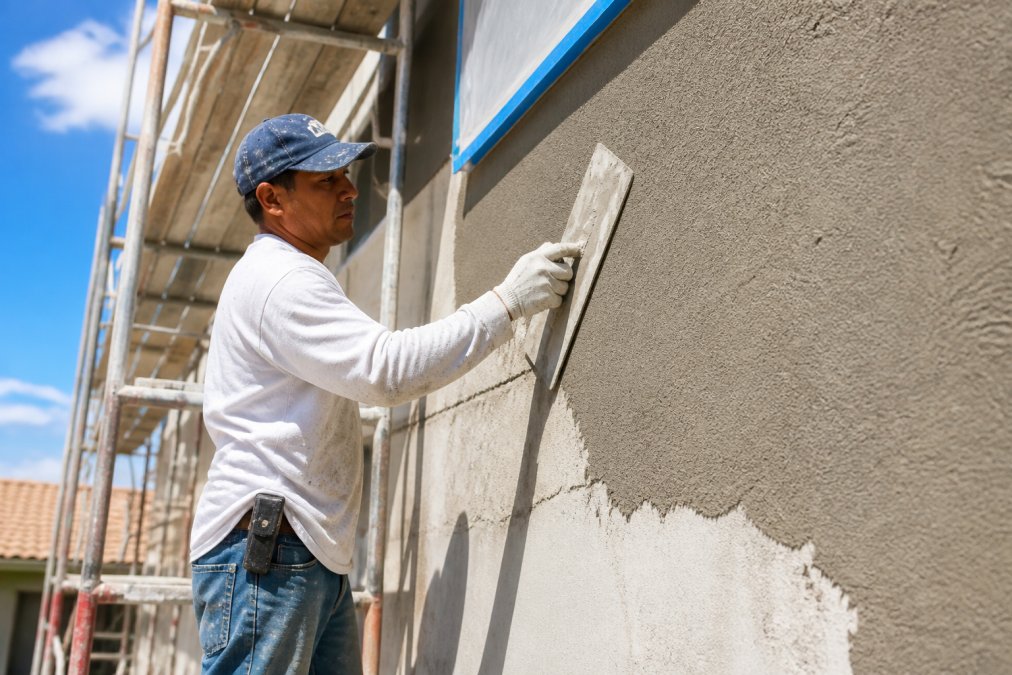
Desert Climate Challenges for Stucco
Desert conditions create a specific set of stucco failure modes that contractors in other regions rarely encounter. Intense UV exposure degrades the finish coat and causes color fade and surface chalking. Thermal cycling, where temperatures swing dramatically between day and night, causes the substrate to expand and contract repeatedly, opening hairline cracks over time. Dust-laden wind acts as an abrasive, accelerating surface wear.
Efflorescence, the white mineral deposit that appears when water moves through masonry and evaporates at the surface, is common after monsoon events. It signals moisture migration and should not be painted over without addressing the source.
A contractor with genuine regional experience will specify elastomeric coatings or high-build finishes that accommodate thermal movement rather than standard portland cement mixes that become brittle in extreme heat. Ask specifically what mix and finish system they intend to use, and why.
Request that the contractor document the existing stucco condition with photos before any work begins. This protects both parties and gives you a baseline for evaluating the repair quality once the job is complete.
Home Remodeling Contractor Checklist Before You Sign Anything
The single most common source of homeowner frustration with contractors is not poor craftsmanship. It is the gap between what was verbally promised and what the contract actually specifies. A written scope of work, signed before any money changes hands, is the only reliable protection.
Use this checklist before committing to any home remodeling contractor:
- Contractor holds a current state contractor’s license (verify directly with the Texas Department of Licensing and Regulation)
- General liability insurance certificate names your property address
- Workers’ compensation coverage is confirmed in writing
- Written scope of work specifies materials by brand, grade, and quantity
- Payment schedule is tied to project milestones, not calendar dates
- Change order process is defined in the contract before work begins
- Project start date and substantial completion date are written in
- Permit responsibility is assigned (contractor pulls permits, not homeowner)
- Lien waiver process is outlined to protect against supplier nonpayment claims
- Warranty terms for both labor and materials are stated explicitly

The Texas Department of Licensing and Regulation administers contractor licensing at the state level for some trades. Roofing contractors and general contractors in Texas are not required to hold a statewide license, but some cities and counties may require local registration. Any contractor who cannot provide their license number on request, if one is required for their trade or locality, is a contractor worth walking away from.
Never pay more than 10-15% of the total project cost as a deposit before work begins. Contractors who demand 50% or more upfront before mobilizing represent a financial risk, regardless of how professional their presentation appears.
How to Verify Contractor Insurance and Licensing
Verifying contractor insurance and licensing is a two-step process that takes less than 30 minutes and can prevent significant financial loss.
Step 1: Verify the license. For Texas contractors, check the Texas Department of Licensing and Regulation contractor lookup for trades they license. For general contractors and roofers, who do not have a statewide license, check with your local city or county for any registration requirements. Search by company name or license number. Confirm the license is active, not expired or suspended, and that the license type covers the scope of your project.
Step 2: Verify the insurance. Ask the contractor to provide a Certificate of Insurance directly from their insurance carrier, not a copy they hand you themselves. The certificate should list general liability coverage and workers’ compensation. Call the insurance carrier’s number on the certificate to confirm the policy is current. An expired policy that looks current on paper is a real risk.
Beyond these two steps, check for BBB accreditation status, review complaint histories on the Better Business Bureau contractor search, and look at verified review platforms for patterns in feedback. A single negative review rarely tells you much. A pattern of complaints about communication, incomplete work, or refund disputes tells you a great deal.
JFC Construction vs. MAK Roofing & Construction: Service Depth Compared
Comparing jfc construction to MAK Roofing & Construction reveals a meaningful difference in documented service depth and operational infrastructure.
| Attribute | JFC Construction | MAK Roofing & Construction |
|---|---|---|
| Years in operation | Since 1983 | Over 16 years |
| Official website | Not found | Yes (elpasoroofings.com) |
| Roofing systems offered | Asphalt, tile, slate, metal, flat/elastomeric | Shingle, metal, flat, spray foam, TPO, elastomeric, silicone |
| Commercial work | Not clearly documented | Residential and commercial |
| Stucco services | Not listed | Yes, climate-specific |
| Financing options | Not documented | Bank financing available |
| Insurance claim assistance | Not documented | Yes |
| GAF certification | Not documented | Yes |
Project Management and On-Time Delivery
Project management is where full-service contractors differentiate themselves most clearly. The question most homeowners actually want answered is simple: will you show up, finish on time, and not disappear mid-project?
MAK Roofing & Construction offers comprehensive project management from start to finish, which means a single point of contact across all phases rather than the homeowner coordinating between trades. For complex projects combining roofing, stucco, and interior remodeling, that integration reduces scheduling gaps and accountability gaps simultaneously.
JFC construction’s directory profile does not address project management structure explicitly. For smaller, single-trade jobs, this may not matter. For multi-phase renovations, the absence of documented project management protocols is worth clarifying before signing.
Financing Options and Budget Compliance
Budget compliance is one of the more practical concerns homeowners raise before committing to a large project. MAK Roofing & Construction offers bank financing options, which means the project does not have to wait until full funds are available. This is a concrete differentiator for homeowners facing urgent repairs, storm damage remediation, or larger remodels where upfront payment is not feasible.
JFC construction does not list financing options in available directory information. If financing is a factor in your decision, verify directly with any contractor whether it is available and what the terms involve.
Sustainability and Construction Methods Worth Asking About
Sustainability in residential and commercial construction has moved from a preference to a practical cost consideration. Energy-efficient roofing materials, improved insulation systems, and low-VOC finishes all affect long-term operating costs, not just environmental impact.
The specific questions worth raising with any contractor include:
Roofing systems: Cool roof coatings and reflective membrane systems reduce heat absorption significantly in desert climates. Spray foam and TPO systems, both offered by MAK Roofing & Construction, provide thermal performance advantages over conventional built-up roofing. Ask any contractor to specify the R-value and solar reflectance index of the system they recommend.
Stucco and exterior finishes: Elastomeric coatings extend the service life of stucco by accommodating thermal movement and reducing moisture infiltration. This reduces the frequency of repair cycles and the associated material and labor costs over a 10-20 year horizon.
Remodeling practices: Low-VOC paints and adhesives, recycled content materials, and proper construction waste disposal are baseline sustainability practices that reputable contractors should be able to address without hesitation.
According to the U.S. Department of Energy’s guidance on energy-efficient home improvements, building envelope improvements including roofing and insulation upgrades consistently rank among the highest-return investments for reducing residential energy consumption in hot climate zones.
The most durable sustainability decision in desert construction is specifying materials designed for thermal cycling and UV exposure from the start. Retrofitting for durability costs more than building it in.
Getting a Quote and What Happens Next
Getting a quote from any contractor should follow a predictable process. A contractor who cannot walk you through their quoting process clearly is often a contractor who has not systematized their operations.
For jfc construction, quotes are available by direct contact through directory listings. Free estimates are offered, which is standard for the local market.
For MAK Roofing & Construction, the process starts with a Video Estimate, which allows the team to assess scope without requiring an immediate site visit for initial scoping. This is a practical efficiency for homeowners dealing with time constraints or who want a preliminary scope before committing to a full consultation.
What to expect after requesting a quote from any qualified contractor:
- Initial scope review, either on-site or via video assessment
- Written estimate with itemized labor and material costs
- Review of timeline, permit requirements, and payment schedule
- Contract execution with defined scope, milestones, and warranty terms
- Permit application and scheduling confirmation before mobilization
The gap between a verbal quote and a signed contract is where most project disputes originate. Do not treat a quote as a commitment until the scope is in writing.
Choosing between jfc construction and other local contractors comes down to documented service depth, verifiable credentials, and the operational infrastructure to manage your specific project scope. For homeowners and property managers who need a single contractor covering roofing, stucco, and remodeling with confirmed financing options and commercial capability, MAK Roofing & Construction’s 16 years of regional experience, GAF certification, and comprehensive project management structure make it a strong option. Request a Video Estimate from MAK Roofing & Construction and get a clear scope and timeline before committing to any contractor.
Frequently Asked Questions
Q: What services does JFC Construction provide?
A: JFC Construction is a family-owned El Paso-area contractor that has offered residential roofing (asphalt, tile, metal, flat systems), kitchen and bathroom remodeling, flooring installation, and patio additions since 1983. The company handles free estimates and targets homeowners dealing with storm damage or general renovation needs. For a broader scope of services, including commercial roofing, spray foam, TPO systems, stucco, and bank financing, MAK Roofing & Construction provides a more comprehensive full-service option.
Q: How do I verify a construction company’s license and insurance?
A: Check the Texas Department of Licensing and Regulation (TDLR) database to confirm a contractor’s active license for trades they license. For general contractors and roofers, who do not have a statewide license, check with your local city or county for any registration requirements. For insurance, ask the contractor to provide a Certificate of Insurance showing general liability and workers’ compensation coverage, then call the issuing insurer directly to confirm the policy is current. Never accept a certificate that lists only the contractor’s name without a verifiable policy number. Unlicensed or uninsured work leaves you liable for on-site injuries and property damage.
Q: What should I look for when hiring a home remodeling contractor?
A: Confirm the contractor holds any required local or state licenses and carries both general liability and workers’ compensation insurance. Request a written contract that specifies scope of work, materials, start and completion dates, and payment schedule. Ask for references from projects completed in the past 12 months and check their standing with the Better Business Bureau. A contractor who offers comprehensive project management from site preparation through final inspection reduces your coordination burden and protects against budget overruns.
Q: Are there multiple companies operating under the name JFC Construction?
A: Yes. Several unrelated businesses use similar names, including JFC Roofing & Design in El Paso and other JFC-branded construction firms operating in different states, such as Jordan Foster Construction which handles large commercial and civil infrastructure projects in El Paso. Before hiring, confirm you have the correct entity by verifying the physical address, any required license number, and BBB profile. Searching a company name alone is not enough to confirm you are dealing with the right business or that it holds the credentials you need for your specific project type.
Q: How do I choose between different construction firms for my home project?
A: Match the contractor’s specialty to your project type. Roofing certifications (such as GAF certification) matter for roof replacements; stucco experience specific to desert climates matters for exterior work. Compare written quotes line by line rather than total price alone, and ask each contractor how they handle schedule delays or material substitutions. A full-service contractor who manages subcontracting, site preparation, and inspections in-house typically delivers better budget compliance and on-time delivery than one who outsources major phases.
This article was written using GrandRanker