

- BY adminMak
- POSTED IN Blog
- WITH 0 COMMENTS
- PERMALINK
- STANDARD POST TYPE
Last Updated: November 4, 2026
Quick Summary
Custom cabinets are built to your kitchen’s exact dimensions and design, while prefab kitchen cabinets come in fixed sizes and styles, ready to install. Prefab cabinetry typically costs $60 to $500 per linear foot, compared with $500 to $1,500 for custom. For most El Paso remodels, stock boxes with upgraded fronts and hardware deliver the look without the bespoke price.
- Custom cabinets are built to the inch for a specific kitchen, with homeowner-chosen door styles, finishes, and interior layouts.
- Prefab cabinets arrive in fixed sizes, usually in increments of a few inches, and installers fill gaps with filler strips and trim.
- Semi-custom cabinets are generally stock boxes with a menu of upgrades such as door fronts and finishes.
- Cabinet lead time, not labor, usually sets the schedule, with stock arriving in days and custom taking several weeks.
- A well-built stock cabinet with plywood boxes and quality hinges will outlast a poorly built custom one.
Table of Contents
- Custom vs Pre-Fabricated Cabinets: The Short Answer
- What Are Custom Kitchen Cabinets?
- What Are Pre-Fabricated (Stock) Cabinets?
- Prefab Cabinets vs Custom Cost: What Drives the Price Gap
- Semi-Custom Kitchen Cabinets Cost: The Middle Option
- Kitchen Cabinet Materials and Construction: What to Inspect
- Kitchen Cabinet Installation Timeline: Lead Times and Labor
- Design Flexibility, Durability, and Resale Value
- Choosing Cabinets for El Paso’s Heat, Dust, and Dry Air
- Booking a Cabinet and Kitchen Remodel Consultation
- Frequently Asked Questions
Custom vs Pre-Fabricated Cabinets: The Short Answer
Custom cabinets are built to your kitchen’s exact dimensions and design; prefab kitchen cabinets come in fixed sizes and styles, ready to install.
Custom kitchen cabinets are built to the inch for a specific kitchen, with door styles, finishes, and interior layouts chosen by the homeowner. Pre-fabricated cabinets, often called stock cabinets, are factory-built in standard widths and depths and sold ready to install.
The gap between them comes down to three things: price, lead time, and how much of your kitchen is an odd shape. Below, we cover the cost drivers, the middle option most homeowners overlook, and what to inspect before you buy.
What Are Custom Kitchen Cabinets?
Custom kitchen cabinets are built to the inch for a specific kitchen, with door styles, finishes, and interior layouts chosen by the homeowner. Nothing is pulled from a shelf. A cabinetmaker works from your measurements, so a 41-inch wall or an angled corner gets a box that fits it exactly.
The trade-off is time and money. Custom work means design drawings, a deposit, and a build schedule measured in weeks, not days. You get exactly what you asked for, and you pay for the labor that makes it possible. For a kitchen with unusual geometry or a strong design vision, that trade is often worth it.
What Are Pre-Fabricated (Stock) Cabinets?
Prefab kitchen cabinets are factory-built in standard widths and depths and sold ready to install. They arrive in fixed sizes, usually in increments of a few inches, and come in a set range of door styles and finishes.
The advantage is speed and predictability. Stock cabinets are on the shelf or a short truck ride away, so a kitchen can move from demolition to install quickly. The limitation is fit: standard dimensions rarely match every wall, so installers fill gaps with filler strips and trim. In a simple, square kitchen, that is barely noticeable. In an older home with out-of-square walls, it shows.
Prefab Cabinets vs Custom Cost: What Drives the Price Gap
The price gap comes from four inputs: materials, labor, customization, and waste. Custom builds use more skilled carpentry hours, more material cut to exact sizes, and more design time. Prefab spreads those costs across thousands of identical units on an assembly line.
Published comparisons put prefabricated cabinetry at roughly $60 to $500 per linear foot, while custom cabinetry runs about $500 to $1,500 per linear foot, according to Olive Branch Woodworking’s cabinet cost comparison.
Here is what actually moves the number inside each range:
- Door style and profile. A flat slab door is the cheapest to machine; a raised-panel or inset door adds milling, assembly, and finishing steps. Inset doors, which sit flush inside the face frame, are the most labor-intensive and typically push a custom quote toward the top of its range.
- Wood species and veneer. Paint-grade maple and MDF are budget-friendly; rift-sawn white oak, walnut, and exotic veneers add material cost and can add finishing time. Factory-finished veneers on stock lines keep cost down because the finish is applied in a controlled spray line, not on site.
- Finish type. A factory-applied conversion varnish or catalyzed lacquer is durable and consistent; a site-applied stain and topcoat adds labor hours and drying time, and it is more sensitive to El Paso’s low humidity during cure.
- Hardware. Standard self-closing hinges and side-mount slides are inexpensive; soft-close undermount slides, tip-out trays, pull-out waste bins, and lift-up wall-cabinet doors add per-unit cost on both prefab and custom lines.
- Installation labor. Stock boxes go in fast because they are square and uniform; custom boxes can require more careful shimming and scribing to out-of-square walls, which adds carpenter hours even though the boxes fit better.
- Waste factor. Custom work can be cut to exact dimensions, which may reduce waste compared with standard sizes plus filler strips.
| Factor | Prefab Cabinets | Custom Cabinets |
|---|---|---|
| Typical cost per linear foot | $60-$500 | $500-$1,500 |
| Lead time | Days to a few weeks | Several weeks or longer |
| Fit to odd walls | Filler strips and trim | Built to exact dimensions |
| Design options | Set styles and finishes | Open choice |
| Best for | Square kitchens, tight budgets | Complex layouts, long-term homes |
Treat any per-foot number as a starting point, not a quote. For current pricing, request a quote from MAK Roofing & Construction. Your actual cost depends on layout, door style, and hardware.
Watch out: per-linear-foot pricing may exclude filler strips, crown molding, toe kick, and delivery, so ask what is included in any quote.
Semi-Custom Kitchen Cabinets Cost: The Middle Option
Semi-custom cabinets are generally stock boxes with a menu of upgrades such as door fronts and finishes, sitting between stock and fully custom options on price and lead time. Ask your contractor which lines allow size tweaks before you choose a finish.
Kitchen Cabinet Materials and Construction: What to Inspect
The cabinet box matters more than the door. A beautiful front on a weak box fails in a few years; a plain front on a solid box lasts decades. Open a display cabinet and look at what holds it together.
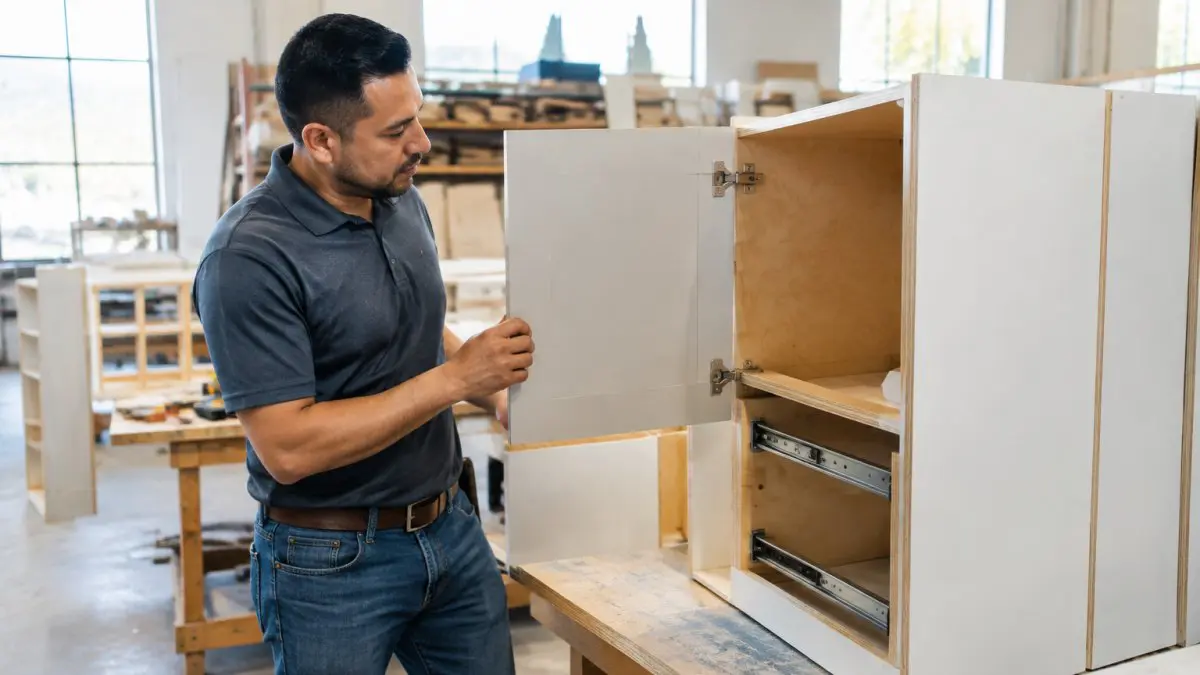
- Plywood construction: layered wood plies, stronger and more moisture-resistant than particle board.
- Particle board: cheaper and common in budget lines; it swells if water reaches the core.
- Solid wood: used for doors and frames; beautiful but can move with humidity.
- Drawer slides and soft-close hinges: the hardware you touch daily; cheap hardware fails first.
- Veneer and laminate: factory finishes that resist wear but cannot be refinished like solid wood.
For a deeper look at how material choice affects comfort and longevity across a whole home, see our guide to durable material selection for property comfort. The U.S.
Kitchen Cabinet Installation Timeline: Lead Times and Labor
Cabinet lead time, not labor, usually sets the schedule. Stock cabinets can arrive in days; custom cabinets often take several weeks from final measurement to delivery. The install itself is fast by comparison, typically a few days for a standard kitchen once the boxes are on site.
Plan the sequence in this order:
- Design and final measurement
- Order or commission cabinets
- Demolition and rough-in work
- Cabinet delivery and inspection
- Installation, then countertop template
- Countertop fabrication and final trim
Because cabinet lead times drive everything downstream, line up your prep work early. Our 7 steps to prepare for a kitchen remodel in El Paso covers what to do before demolition starts so the schedule does not stall while you wait on boxes.
Design Flexibility, Durability, and Resale Value
Custom cabinetry wins on design flexibility and often on resale value, because buyers notice a kitchen that fits together. Prefab typically costs less upfront.
Design flexibility. Custom work can be built to specific dimensions, which can reduce the need for filler strips on unusual layouts.
Durability. A well-built stock cabinet with plywood boxes and quality hinges will outlast a poorly built custom one.
Repairability. This is where the two paths diverge over a decade of ownership. A custom build can make it easier to reproduce a damaged door or match a finish, since the drawings and finish specifications are documented. A discontinued prefab line may have no matching door or hinge available, which can force a partial refacing or a mismatched replacement.
To see how the design and durability payoff looks in a completed space, browse our modern kitchen install project gallery.
Choosing Cabinets for El Paso’s Heat, Dust, and Dry Air
El Paso’s dry air and summer heat stress cabinetry in ways coastal guides ignore. Wood expands and contracts with humidity swings, and fine dust settles into every open shelf and drawer gap. Choose materials and finishes that suit low humidity and temperature swings.
- Prefer plywood boxes over particle board where budget allows; they hold up better to dry-air movement.
- Choose factory-applied finishes over site-finished wood, which is more sensitive to humidity changes.
- Specify sealed or easy-clean interiors to keep dust from settling into raw surfaces.
- Avoid solid wood slab doors in full sun; they move more than frame-and-panel designs.
If you are weighing a full renovation, our kitchen remodeling services cover design through installation, and you can discuss your space with our team before you commit to a cabinet line. Homeowners looking for kitchen remodeling in the El Paso area can start by discussing their space with a contractor.
Booking a Cabinet and Kitchen Remodel Consultation
The right cabinet choice depends on your walls, your budget, and your timeline, and none of that is settled until someone measures your kitchen. With over 16 years of experience, MAK Roofing & Construction handles projects from start to finish, so you can discuss your project with our team.
Before you book, read our guide on how to choose a kitchen remodel contractor in El Paso so you know what to ask. Then bring your questions to a consultation and we will help you weigh stock, semi-custom, and custom options against your space and budget.
Frequently Asked Questions
Are custom kitchen cabinets worth the extra cost?
They can be, when your kitchen has odd dimensions, you plan to stay in the home for years, or you want a specific door style and finish that stock lines do not offer. Custom cabinetry is built to your exact measurements, so space optimization is better and storage can be tailored. If your layout is standard and budget is tight, prefab kitchen cabinets deliver solid value and leave room in the budget for countertops, appliances, or other renovation work.
How much do custom kitchen cabinets cost compared with pre-fabricated cabinets?
Cabinet pricing varies widely by materials, craftsmanship, and design. For current pricing, request a quote from MAK Roofing & Construction. The gap reflects materials, skilled carpentry craftsmanship, and bespoke design work. Exact pricing for your project depends on kitchen footprint, door styles, finish, and hardware, so ask your contractor for a written quote rather than relying on averages.
Are pre-fabricated cabinets durable enough for a kitchen remodel?
Many stock cabinets hold up well when the cabinet box uses plywood construction rather than particle board, and when drawer slides and soft-close hinges are quality hardware. Durability depends more on construction than on the custom-versus-stock label. Check the box material, how the joints are fastened, and whether the finish is laminate, veneer, or solid wood. In a hot, dry climate, well-built stock cabinets with a stable finish can last for decades.
How long does it take to get custom kitchen cabinets?
Custom cabinetry typically takes several weeks longer than stock because each cabinet is built to order. The kitchen cabinet installation timeline includes design and measurement, fabrication, delivery, and then installation itself. Stock cabinets can often be delivered in days or a few weeks if the sizes are in stock. Build lead time into your remodel schedule early, since cabinets usually arrive before countertops are templated.
Should I choose semi-custom or fully custom kitchen cabinets?
Semi-custom cabinets generally start from standard sizes and allow some adjustment to dimensions, door styles, and finishes. Semi-custom kitchen cabinets cost more than stock but less than bespoke cabinetry. Choose fully custom when you need exact fits, built-in features, or a one-of-a-kind look. For many remodels, semi-custom is the practical middle ground.
Cabinet decisions get easier once someone measures your actual kitchen and shows you what fits. MAK Roofing & Construction offers full-service remodeling with bank financing options and comprehensive project management from start to finish. Get started with MAK Roofing & Construction and choose cabinets that fit your space, your budget, and El Paso’s climate.
